
Last Sunday, Melissa Benyon and I went up to Plants for a Future, near Lostwithiel, for a visit.
Plants for a Future is a 28-acre piece of land, bought in 1989 as a place to demonstrate the many uses of plants, with a strong emphasis on perennial species. About half the land is given over to native tree planting, the rest is planted with a dizzying array of plants and trees.
As we drove, we realised we were heading somewhere special: the lanes got smaller and smaller as the nearest main road retreated further and further away, until we ended up just a couple of miles from the sea.
We were greeted by Addy Fern, who has worked alongside her husband Ken on the land for decades.
The structure of the day was that we’d spend the morning volunteering, have lunch together, then Addy would give us a tour of the land in the afternoon.
Six volunteers arrived in total, including us. We had a quick cup of tea, introduced ourselves, and then went off to do ‘a bit of volunteering’. Actually, Addy had planned a decent session of hard work; we definitely earned our lunch!
Adjacent to the natural woodland is an arboretum that included a stand of several Monkey Puzzle trees that have been growing for over 20 years — the length of time it takes to reach maturity and start producing fruit. Addy was keen for them to have the best chance of producing their first fruits, but the base of each tree had been smothered in brambles, and other trees were crowding them.
Volunteers from a previous session had already been working on clearing the Monkey Puzzles, so by the time we arrived there were only really two that still needed clearing.
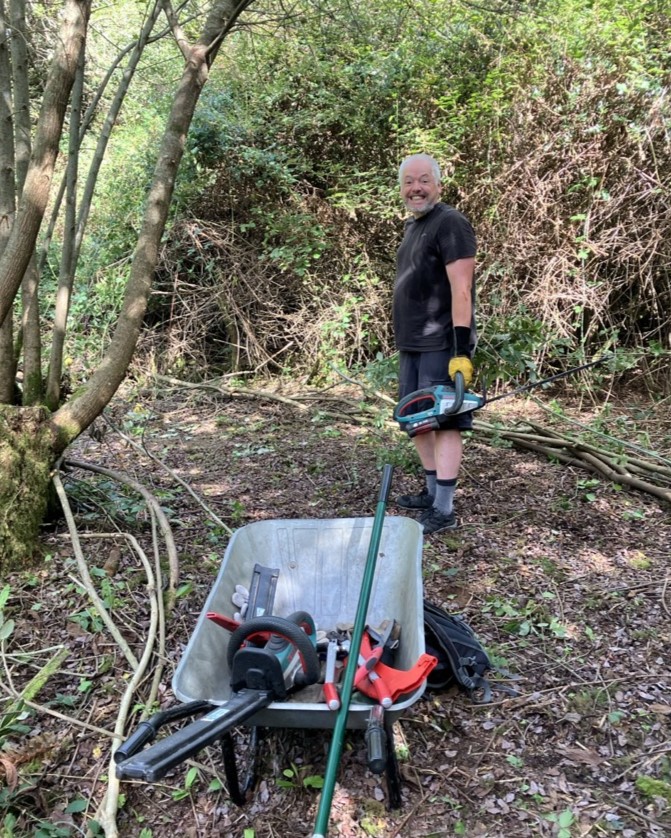
I had my first go on an electric hedge trimmer, much easier to use than I’d imagined, and great for clearing brambles!
As we started opening up the space around one Monkey Puzzle, we decided that a couple of Willows and one Japanese Walnut were too close. The Japanese Walnut had self-seeded and there are others on the property in a more suitable location. So although it felt odd cutting down a semi-mature hardwood, I reminded myself that a weed is simply a plant in the wrong place, and the tree would make useful firewood and mulch. The Willows were cut down to coppice height, so they will continue producing wood.
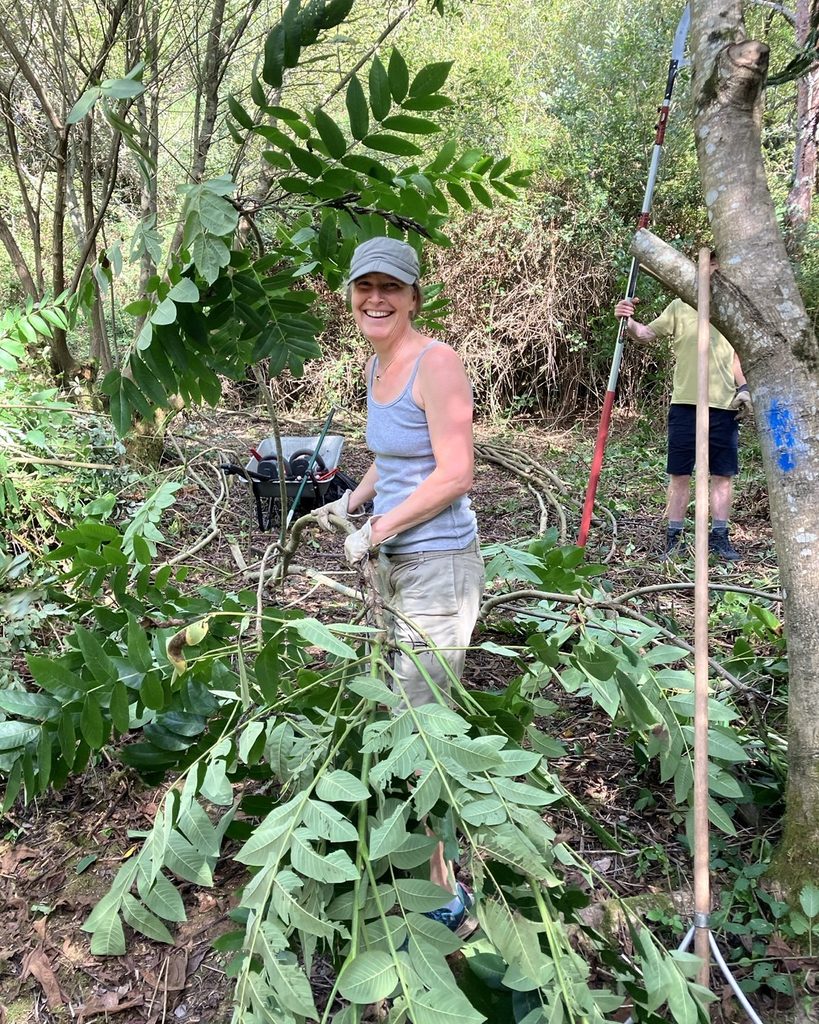
As we cut back the brambles and opened up the space, we could feel the sun’s heat reaching into what had been quite a dark, shaded spot. You can see the difference in the before and after pictures below:
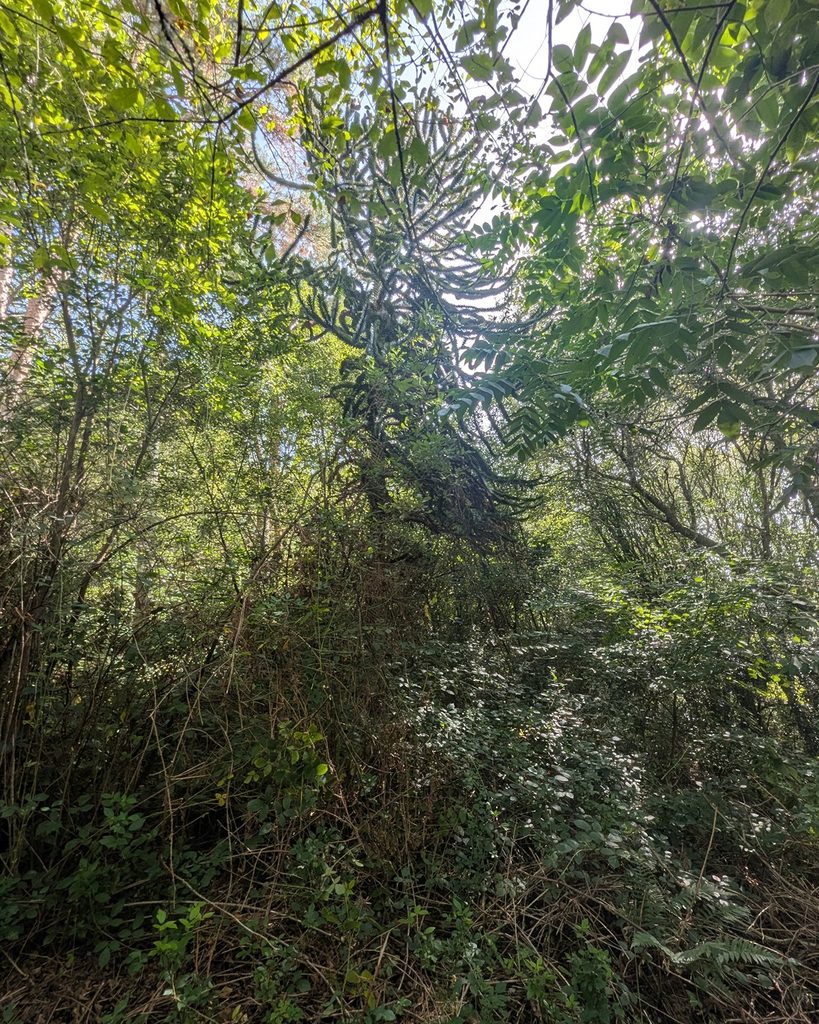
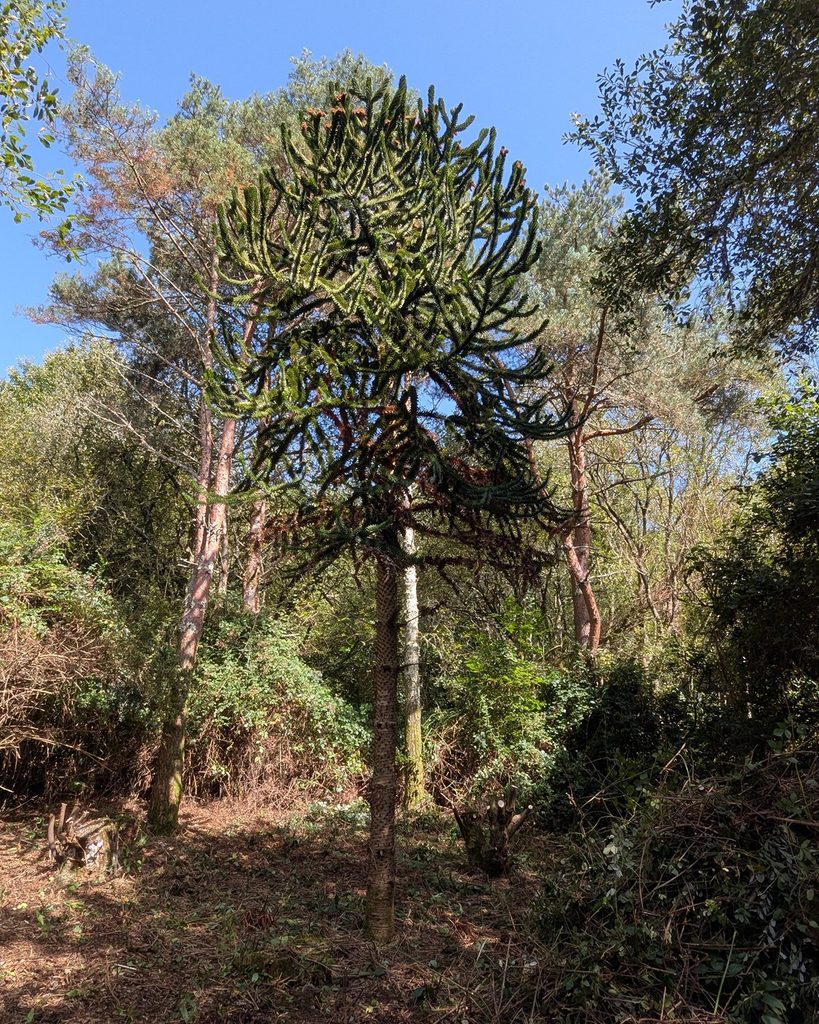
The second Monkey Puzzle was hemmed in by bamboo so we spent a while cutting out a small stand. This included digging out a bucket that had been rooted to the ground by bamboo growing through it!
With some spare time, we also cleared a lot of bramble from a Darwin’s Barberry (Berberis darwinii), a tree I’d never come across before, an evergreen with leaves similar to a small holly, which produces edible fruit. There are also deciduous barberries at Plants for a Future, and as we saw later in the day, an enormous variety of other edible fruit across the site, much of which I’d never seen or tasted before.
Hot and sweaty, we finally broke for lunch, having dug up a few self-seeded saplings that were in the wrong place and which were offered to volunteers to take away. Ironically, one of these was a Japanese Walnut, which will hopefully find its way to a more suitable spot.
Over lunch, Addy talked about the project and how they’ve tried to meet their vision over the years, despite various challenges along the way, such as the council planning department and Covid. She showed us before-and-after pictures of the site; it was so inspiring to see somewhere that was literally a single bare field, transformed into a rich and complex woodland and growing space.
After we’d eaten, Addy took us around the site in more detail, giving us samples to taste of dozens of perennials, including multiple varieties of the same plant, such as alliums, sorrels, mallows, and others I’ve probably forgotten. We saw numerous fruit trees with multiple varieties, such as several types of hawthorn, and a damson tree so full of fruit that we stood around eating from it for five minutes without seemingly making any difference to the display.
We got an insight into pollarding, and lots of tips on propagation, growing from seed, when to harvest, what trees are good for windbreaks (alder and pine), what plants benefit our health in different ways, and more. Addy has a deep knowledge of plants and their benefits, and I was so grateful that she is prepared to share it.
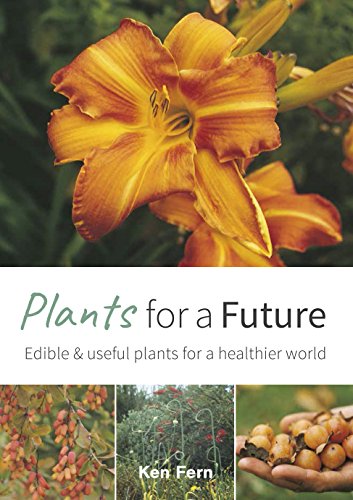
Speaking of knowledge sharing, Ken Fern has written a book, full of information on food plants and other useful plants. It is focused on methods of growing these plants in ways that are in harmony with the local environment and can help to improve the overall health of the planet.
Plants for a Future : Edible & Useful Plants for a Healthier World — Ken Fern
Buy on Abe Books
We talked about possibly going back later in the year and exchanging volunteer work for seeds or fruit, instead of another tour. It seemed like a really good way of exchanging effort for knowledge, and the chance to spread a variety of plants and increase biodiversity.
Looking back, it was a fabulous visit, and I would highly recommend that others visit Plants for a Future whenever there’s an opportunity!
Thanks to Melissa for my hedge trimming photo! (And driving, and being great company)